Choosing the Right Nitrogen Gas Manufacturer: Key Factors to Consider

Choosing the right nitrogen gas manufacturers is very important for your work. The global nitrogen market is worth about USD 30.4 billion in 2023 and is expected to grow to USD 44.28 billion by 2030. 🌍 You need to understand your needs now more than ever. Many industries require nitrogen gas, including food preservation and electronics. For example, in food and drink production, nitrogen replaces oxygen, helping food last longer. With many nitrogen gas manufacturers to choose from, picking the right one can significantly affect your efficiency and costs.
Key Takeaways
Know what you need for nitrogen. This includes how pure it should be and how much you need. This helps you pick the right manufacturer for your uses.
Check out manufacturers. Look at their reputation, safety records, and quality certifications like ISO. This helps you find reliable products.
Think about how manufacturers make nitrogen. On-site generation can save money and help the environment.
Look at how reliable nitrogen systems are. Pay attention to maintenance needs to prevent problems.
Compare both the starting costs and long-term costs. This helps you find the best money option. On-site generation usually saves a lot of money.
Nitrogen Requirements
When you pick a nitrogen gas manufacturer, knowing your nitrogen needs is very important. Different uses need different purity levels and amounts of nitrogen gas. Let’s explain it simply.
Purity Levels
Purity is a big part of the quality of nitrogen gas for your use. Different industries have different rules for nitrogen purity. Here’s a quick look at the usual purity levels needed:
Industry | Purity Level (%) |
|---|---|
Food Processing | 98 - 99.5 |
Pharmaceuticals | 97 - 99.99 |
Electronics | 99.99 - 99.999 |
Electronics (lower) | 95 - 99.5 |
As you can see, the purity level can really affect your work. For example, food processing needs lower purity than electronics. Even tiny impurities can change how electronics work. Always check how sensitive your application is to impurities like oxygen and moisture.
Volume and Capacity
Next, think about how much nitrogen gas you need. Your needs can change based on how big your operation is. Here are some things to remember:
Small operations often use bottled nitrogen gas. This choice is easy but might not provide a steady supply.
Large operations do better with nitrogen generation equipment. Even though it costs more at first, it gives a steady and efficient supply.
Cryogenic systems are good for big production, while PSA and membrane technologies are cheaper for smaller uses.
You should also check your flow rate needs. Measure your highest nitrogen usage to find out how much gas you’ll need. This will help you choose the right nitrogen gas manufacturer that can meet your specific volume and capacity needs.
By knowing your nitrogen requirements, you can make smart choices that improve your efficiency and lower costs.
Evaluating Nitrogen Gas Manufacturers
When you search for a nitrogen gas manufacturer, their reputation is important. A good reputation shows the quality and trustworthiness of their products. Here are some key things to think about when checking a manufacturer’s reputation:
Manufacturer Reputation
You should look at different factors to judge a manufacturer’s reputation. Here’s a quick list:
Criteria | Description |
|---|---|
Product Purity Levels | Checking how pure the nitrogen gas is from the manufacturer. |
Safety Records | Looking at the history of safety problems and recalls linked to the manufacturer. |
Production Capacity | Checking if the manufacturer can meet demand based on how much they can produce. |
Delivery Infrastructure | Examining how reliable the supplier's delivery systems are. |
Customer reviews and industry certifications are also very important for a manufacturer’s reputation. For example, picking a manufacturer that is ISO certified means you get high-quality products. Customer feedback helps you understand how reliable nitrogen generators are.
"Potential and existing customers know that meeting the ISO 9001 standard means we have a formal way to get customer feedback. This gives us credibility because they see that our work is based on customer satisfaction."
Quality Assurance
Quality assurance is another key point when choosing nitrogen gas manufacturers. You want to make sure the products you get are safe and consistent. Manufacturers need to follow different quality assurance standards and certifications. Important standards include ISO 9001, which focuses on keeping quality management practices steady, FDA rules for medical gases, and HACCP guidelines for food-grade gases. These certifications make sure the gases produced meet the needed purity and safety standards for different industries.
By focusing on these points, you can make a better choice when picking a nitrogen gas manufacturer. A trustworthy manufacturer with strong quality assurance will help you keep efficiency and safety in your work.
Technology Options
When you choose a nitrogen gas manufacturer, knowing how nitrogen is made is very important. Different ways to produce nitrogen can change both efficiency and cost. Let’s look at the most common methods and what makes them special.
Production Methods
You have many choices for making nitrogen gas. Each choice has its own benefits and costs. Here’s a quick look at the most common methods:
Source of Nitrogen | Cost per Nm³ (₹) | Notes |
|---|---|---|
Liquid Nitrogen | ₹13 – ₹25 | Prices change based on how far you are from the production plant. |
High-Pressure Cylinder | ₹70 – ₹150 | Costs depend on where you are located. |
Most uses need 99.5% to 99.99% purity, making this method cheaper. |
Pressure Swing Adsorption (PSA) nitrogen generators are the best choice for saving money. They make nitrogen on-site using air from the environment. This cuts down on costs and the need for suppliers. This method also lowers risks and reduces carbon emissions, making it a smart choice for many businesses.
Innovations in Generation
Technology keeps changing, and new ideas have made nitrogen production better. Here are some important improvements:
Cryogenic Distillation: This method aims to lower costs and save energy. New tools help recover and reuse energy during the process.
Hybrid Systems: These mix different ways to make nitrogen, balancing cost, purity, and energy use.
Modern PSA Systems: They use better materials for faster gas collection and release, which greatly reduces energy use.
These improvements lead to better energy savings, more reliability, and less harm to the environment. For example, making nitrogen on-site removes the need for transportation, which cuts carbon emissions. Overall, these innovations make nitrogen production not only more efficient but also more eco-friendly.
By knowing these technology options, you can make smart choices when picking nitrogen gas manufacturers that fit your needs and goals for sustainability.
Reliability and Performance
When you pick a nitrogen gas manufacturer, reliability and performance matter a lot. You need a system that works well all the time. It should meet your production needs without stopping. Let’s look at the important parts of performance and maintenance.
Performance Characteristics
Knowing how nitrogen systems perform helps you make smart choices. Here’s a quick look at different systems and what they offer:
Characteristic | Description |
|---|---|
Cylinders and Dewars | Good for small and medium operations; easy to move and store. |
Bulk Gas Supply System | Best for large production, giving plenty of nitrogen support. |
On-site Nitrogen Generation System | Cost-effective and efficient, making nitrogen from the air for a steady supply. |
Cost Advantage | Lowers long-term costs by cutting out cylinder transport. |
High Safety | Reduces safety risks from moving high-pressure cylinders. |
Unlimited Gas Source | Provides gas whenever needed, ensuring 24-hour production without breaks. |
Environmentally Sustainable | Cuts down carbon emissions from transport, matching green production goals. |
By looking at these features, you can find a nitrogen system that meets your needs while being reliable.
Maintenance Needs
Regular maintenance is key to keeping your nitrogen gas system working well. Different systems need different maintenance schedules, which can affect how often they run. Here’s a look at common maintenance needs:
System Type | Key Maintenance Tasks | Expected Lifespan | |
|---|---|---|---|
Once a year | Change filters, replace carbon media, run diagnostics | Up to 15+ years | |
Membrane Systems | Twice a year | Change elements, check compressors, assess membranes | Up to 5+ years |
Ignoring maintenance can cause problems like:
Oil and water contamination
Lower nitrogen purity
Pressure drops
Total system failure
Different manufacturers have various maintenance options. Some systems, like PSA systems, need little upkeep, mainly routine checks. Others, like membrane systems, might need more frequent changes.
When thinking about after-sales support, look for manufacturers that offer good service agreements. This can help you avoid extra costs from downtime and keep performance strong.
By focusing on reliability and understanding maintenance needs, you can choose a nitrogen gas manufacturer that helps your operations run smoothly.
Installation and Space Considerations
When you want to set up a nitrogen gas system, think about the installation and space needed. Getting these things right can save you time and trouble later.
Installation Process
Setting up a nitrogen gas generation system has several important steps. Here’s a simple list of what to expect:
Site Preparation: Make sure there is enough space, check the electrical needs, and keep the environment stable.
Unpacking and Positioning: Carefully take out the generator and place it according to your plan.
Electrical and Mechanical Setup: Connect the generator to the power source and link it to your gas system.
Initial Startup and Calibration: Clean the system, adjust the generator, and run tests to check the output.
Maintenance and Troubleshooting: Follow the maintenance schedule from the manufacturer and check performance often.
Safety Considerations: Set up emergency plans, ensure good ventilation, and do regular inspections.
Tip: Remember to connect your nitrogen system with current lab systems. Good piping and monitoring can really help efficiency.
Space Requirements
Now, let’s discuss space. The space needed for nitrogen systems can be different. On-site nitrogen generators usually need less space than you might think. Even big systems have small footprint needs.
Here’s a quick look at some site requirements to remember:
Requirement | Description |
|---|---|
Space | Make sure there is enough space for the nitrogen generator, which can change based on your needs. |
Infrastructure | You need piping from the compressed air supply; existing pipes may work. |
Power Source | A small power supply is needed, similar to a desktop computer. |
Ventilation | Good ventilation is needed to remove waste gases from the generator area. |
On the other hand, nitrogen cylinders need more space and careful handling. You’ll need special areas for storage and safety measures for high-pressure cylinders.
By knowing the installation steps and space needs, you can set up your nitrogen gas system safely and efficiently. This planning will help you avoid problems and keep your work running smoothly.
Cost and ROI Analysis
When you think about a nitrogen gas manufacturer, knowing the costs is very important. You need to look at both the starting costs and the long-term costs. This helps you make a smart choice that helps your business over time.
Initial Investment
The starting costs can change a lot based on whether you pick nitrogen cylinders or an on-site nitrogen generator. Let’s look at the costs for both choices.
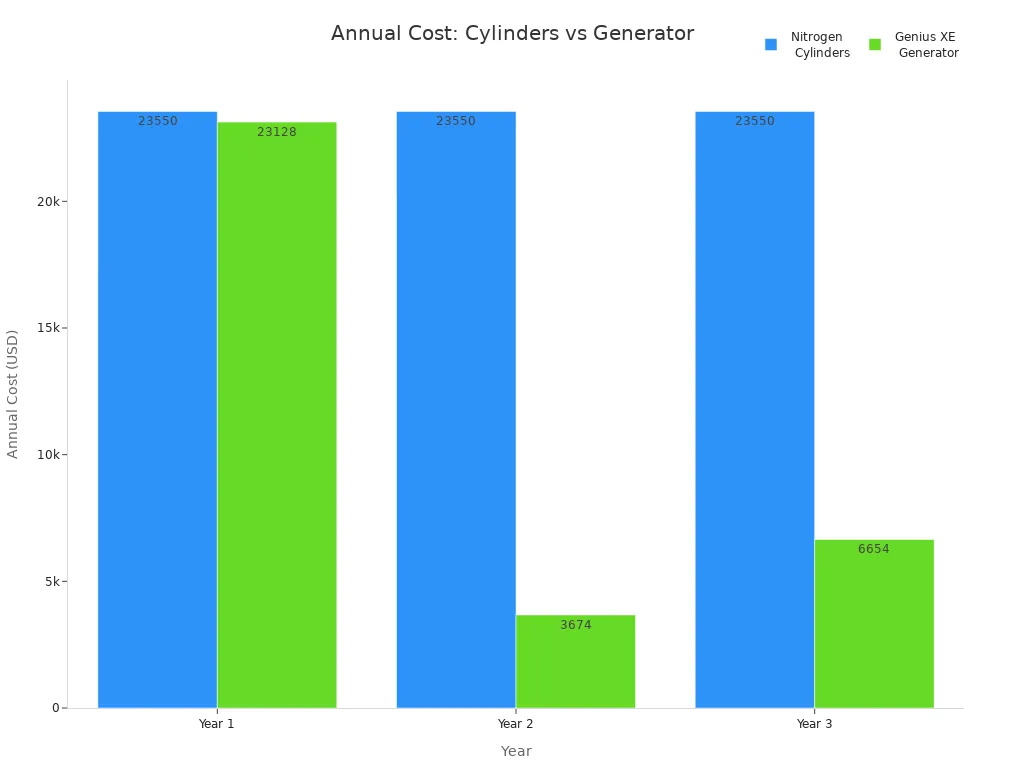
Here’s a comparison of the costs over three years:
Cost Type | Year 1 | Year 2 | Year 3 | Total |
|---|---|---|---|---|
Nitrogen Cylinders | $20,250 | $20,250 | $20,250 | $60,750 |
Cylinder Rental | $600 | $600 | $600 | $1,800 |
Delivery Cost | $2,700 | $2,700 | $2,700 | $8,100 |
$70,650 |
Cost Type | Year 1 | Year 2 | Year 3 | Total |
|---|---|---|---|---|
Genius XE Generator | $22,578 | $0 | $0 | $22,578 |
Maintenance Plan | Warranty | $3,124* | $6,104 | $9,228 |
Power Consumption | $550 | $550 | $550 | $1,650 |
Total Cost for Generator | $33,456 |
As you can see, the total cost for using nitrogen cylinders over three years is much higher than buying a nitrogen generator. The upfront cost of the generator might look high, but it pays off quickly.
Long-Term Operational Costs
Long-term costs are also very important. Making nitrogen on-site can save you a lot of money over time. Here are some key points to think about:
On-site nitrogen generation costs between $0.08 to $0.14 per 100 CF ($0.03 to $0.05 per m³).
Traditional nitrogen supply costs range from $0.40 to over $3.00 per 100 CF ($0.15 to $1.00 per m³).
High-volume users can save a lot by switching to on-site generation.
By making nitrogen on-site, you cut out costs for cylinder rentals and delivery fees. You also lower handling and storage costs for high-pressure nitrogen cylinders. Plus, you get a steady supply of nitrogen, which helps avoid production stops.
When looking at the return on investment (ROI) for a nitrogen generator, think about these factors:
Starting costs
Ongoing maintenance costs
Operational costs
Savings on cylinder rentals
Transportation costs
Employee productivity and safety
You should also consider hidden costs. For example, when renting cylinders, businesses often waste about 10% of the nitrogen because of leftover gas. This waste can lead to big losses over time.
Switching to a nitrogen generator can cut operational costs by 40-90% compared to traditional delivery methods. Many businesses see a quick ROI within 12-24 months because of these savings.
Choosing the right nitrogen gas manufacturer is very important for your business. Here are some key points to remember:
Compliance with Industry Standards: This keeps things safe and reliable.
Certifications: Look for ISO certifications that show quality management.
Environmental Considerations: Choose manufacturers that care about sustainability.
Customer Support: Good technical help is key for smooth operations.
By making a smart choice, you can improve efficiency and save money over time. A good manufacturer uses the right technology and keeps the purity levels correct. Also, strong customer support helps reduce downtime, so your operations run well. 🌟
FAQ
What is nitrogen gas used for?
Nitrogen gas is used in many industries. It helps keep food fresh, makes electronics, and is used in medicine. It stops oxidation and keeps products good by pushing out oxygen.
How do I determine my nitrogen purity needs?
To find out how pure your nitrogen needs to be, think about what you are using it for. Different industries need different purity levels. For example, food processing usually needs 98-99.5% purity, while electronics often need 99.99% or more.
What are the benefits of on-site nitrogen generation?
Making nitrogen on-site has many benefits. It can lower long-term costs, provide a steady supply of nitrogen, and cut down on transportation emissions. It also reduces risks from handling high-pressure cylinders.
How often should I maintain my nitrogen system?
How often you need maintenance depends on the type of system. PSA systems usually need maintenance once a year, while membrane systems might need it twice a year. Regular checks help keep performance and purity levels high.
Can I switch nitrogen suppliers easily?
Yes, you can change nitrogen suppliers. But make sure the new supplier meets your needs for purity, volume, and service. Check their reputation and quality assurance practices before you switch.