Choosing the Right 8.5x11 Paper for Your Printing Needs

Choosing the right paper can make a huge difference in your printing projects. Whether you're printing documents for work or photos for your home, the paper you select impacts the quality and satisfaction of your prints. You want your prints to look sharp and vibrant, right? Factors like weight, finish, and brightness all play a role in how your final product turns out. So, let’s dive into what makes the perfect 8.5x11 paper for your needs!
Key Takeaways
Pick the right kind of 8.5x11 paper for your project. Standard copy paper works well for everyday documents. Premium paper improves quality for important prints.
Think about the weight of the paper. Heavier paper is strong and lasts longer. Lighter paper saves money and lowers the chance of printer jams.
Choose the right finish for your prints. Glossy finishes make colors pop. Matte finishes are better for documents with a lot of text.
Notice the brightness levels. Brighter paper makes prints clearer and more colorful. This is important for professional documents and marketing materials.
Try different textures to improve how your prints feel. Special textures can add depth and character. This makes your printed materials more interesting.
Types of 8.5x11 Paper
When you pick the right 8.5x11 paper, knowing the types can help you decide. Each type has a special use and can change how your prints look.
Standard Copy Paper
Standard copy paper is the best choice for daily printing. It’s cheap and works well for text documents. You can use it for letters, reports, and flyers. This paper usually weighs 20 lb and has a brightness of 92-96. While it’s good for general use, it might not give you the sharpness or brightness you want for high-quality pictures.
Premium Paper
If you want better prints, premium paper is the best option. This paper has a clay coating that makes colors brighter and sharper. Prints on premium paper look more professional. It’s great for important documents or presentations. It’s heavier and smoother than standard copy paper, making colors and text stand out nicely. Here’s a quick look at how premium paper is different from standard copy paper:
Coated paper absorbs less ink, giving sharper images and brighter colors.
Glossy finishes make colors pop, while matte finishes help with reading text-heavy documents.
Premium paper's higher opacity gives a professional look, especially for double-sided printing.
Cardstock
Cardstock is thicker than regular paper, making it great for strong projects. You can use it for business cards, invitations, and postcards. It comes in different weights, usually from 10pt to 32pt, so you can pick the thickness you need. Here’s a quick look at what cardstock is used for:
Uses | Thickness Range |
|---|---|
Packaging | 10pt to 32pt |
Business Cards | 10pt to 32pt |
Invitations | 10pt to 32pt |
Marketing Materials | 10pt to 32pt |
Cardstock is a flexible choice that adds a professional feel to your printed items.
Specialty Papers
Specialty papers have unique textures, finishes, and colors, making them great for creative projects. Whether you’re making custom invitations or special marketing materials, specialty papers can improve your work. Here are some examples of specialty papers you might like:
Specialty Paper | Unique Properties |
|---|---|
Xerox® Revolution® Specialty Media | Customizable, easy to print, guaranteed performance, great for personalized promotions and creative marketing materials. |
NCR Specialties Tag White Coated Front | Carbon-free, readable to the last layer, made for custom multi-part forms. |
Plike Paper | Plastic-like feel, acid-free, long-lasting, works with laser printers, gives unique printing results. |
These choices let you show your creativity and leave a lasting impression.
Factors to Consider for 8.5x11 Paper
When you pick 8.5x11 paper, many things can change how your prints look. Let’s look at the main points you should think about.
Weight
The weight of the paper is very important for your prints. Standard copy paper usually weighs between 20 lb (75 gsm) and 24 lb (90 gsm). Here’s why weight is important:
Heavier papers are stronger and last longer.
Lighter paper, like 20 lb, is less likely to jam and costs less, making it good for lots of printing.
Different printers work better with certain paper weights. Using the wrong weight can cause jams or bad prints.
Picking the right weight helps your prints look good and last longer.
Finish
The finish of your paper can change how your prints look in a big way. Here are some important things about paper finishes:
A coated finish makes printed designs look more professional.
It helps colors stay bright and last longer because of better color transfer.
The smooth surface helps with clarity and quality, making it great for sharp designs.
Here’s a quick look at common finishes and where to use them:
Finish Type | Characteristics | Recommended Applications |
|---|---|---|
Red River Premium Matte | Smooth, bright white finish producing brilliant color and sharp detail. | Ideal for high-quality photo prints. |
68lb UltraPro Satin Photo Paper | Elegant satin finish that complements any photo subject, bright white for contrast. | Great for professional photography prints. |
68lb UltraPro Gloss Photo Paper | Brilliant white finish, resin-coated for bright colors and sharp details. | Suitable for vibrant photo prints. |
Palo Duro Etching 315 | OBA-free archival paper made from 100% cotton rag, ideal for fine art prints. | Best for museum quality and conservation prints. |
Choosing the right finish can make your prints stand out.
Brightness
Brightness shows how much light the paper reflects. Higher brightness can make your prints look clearer and more colorful. Here’s what to know:
Brightness levels usually go from 80 to 100. The higher the number, the brighter the paper.
Bright paper makes colors pop and text easier to read.
For important documents or marketing materials, choose brighter paper for a polished look.
Texture
The texture of your paper can give a special feel to your prints. Different textures can create different experiences. Here are some points:
Textures can feel like real paper, making designs more relatable.
They add warmth and depth to digital art, making it feel more real.
You can try different textures, from smooth to rough, to get the look you want.
Here’s a table of popular textures and how they feel:
Paper Type | Texture Description | Tactile Experience |
|---|---|---|
Hahnemühle William Turner | Traditional mould-made watercolor paper | Unique tactile feel, ideal for FineArt applications |
Hahnemühle Baryta Satin | Subtly textured, smooth base | Refined for FineArt applications, no optical brighteners |
Fabric Textured Glossy Photo Paper | Soft-to-the-touch images | Perfect for crafts, smudge-free, water-resistant prints |
Palo Duro Baryta Fiber 300 | Exceptional weight and feel | Substantial presence, easy to handle, subtle texture adds character |
Choosing the right texture can improve the overall feel of your printed materials.
Use Cases for 8.5x11 Paper

You can use 8.5x11 paper for many different things. Let’s look at some common ways people use it.
Home Printing
For home printing, 8.5x11 paper is the best choice. It works well for tasks like printing school work, recipes, or family pictures. Most homes use this size of paper for these jobs. Here’s a quick look at common formats:
Format | Size in Inches | Usage |
|---|---|---|
Letter | 8.5 x 11 | Standard for everyday office print-outs and academic documents |
Legal | 8.5 x 14 | Used for contracts and legal documents |
Tabloid | 11 x 17 | Used for tabloids, newsletters, or smaller newspapers |
Professional Documents
In the work world, the right paper matters a lot. You want your papers to look nice and impressive. Here are some tips for choosing paper for work:
Use heavier paper (24lb or 32lb) for a stronger feel.
Pick a matte finish to look more professional.
Thicker paper stops show-through, making double-sided prints look better.
These choices help your documents stand out in meetings or presentations.
Art Prints
Artists know that the right paper can make their work better. When printing art, you want colors to pop and details to shine. Here are some important points to think about:
Picking the right paper is key for great art prints.
The paper type affects colors, details, and overall quality.
Different textures can change the depth and mood of an image.
Smooth papers are best for high-resolution images. They give a clean and sharp look. Such papers allow for great color reproduction and clarity.
Marketing Materials
For marketing, 8.5x11 paper is very useful. You can use it for flyers, brochures, and menus. Here’s how to make the most impact:
The 8.5x11 flyer is great for menus and promotional overviews.
It gives enough space for detailed designs and information.
Different material options include glossy, matte, and uncoated finishes, each serving specific design needs.
Finishing options like gloss lamination and UV varnish make your marketing materials look better and last longer.
Cost Comparison of 8.5x11 Paper
When you buy 8.5x11 paper, you will see many prices. Knowing these prices can help you choose the best paper for your needs without spending too much.
Budget-Friendly Options
If you want to save money, budget-friendly paper is a good choice. Here are some popular options you can find at big stores:
Product Description | Price |
|---|---|
Wexford Multipurpose Paper 8.5x11 | |
Wexford Recycled Paper 8.5x11 | $7.99 |
Wexford Multipurpose Paper 8.5x11 (500 sheets) | $10.99 |
Walgreens Premium Photo Paper 8.5x11 | $12.99 |
Wexford Multipurpose Recycled Paper 8.5x11 | $12.99 |
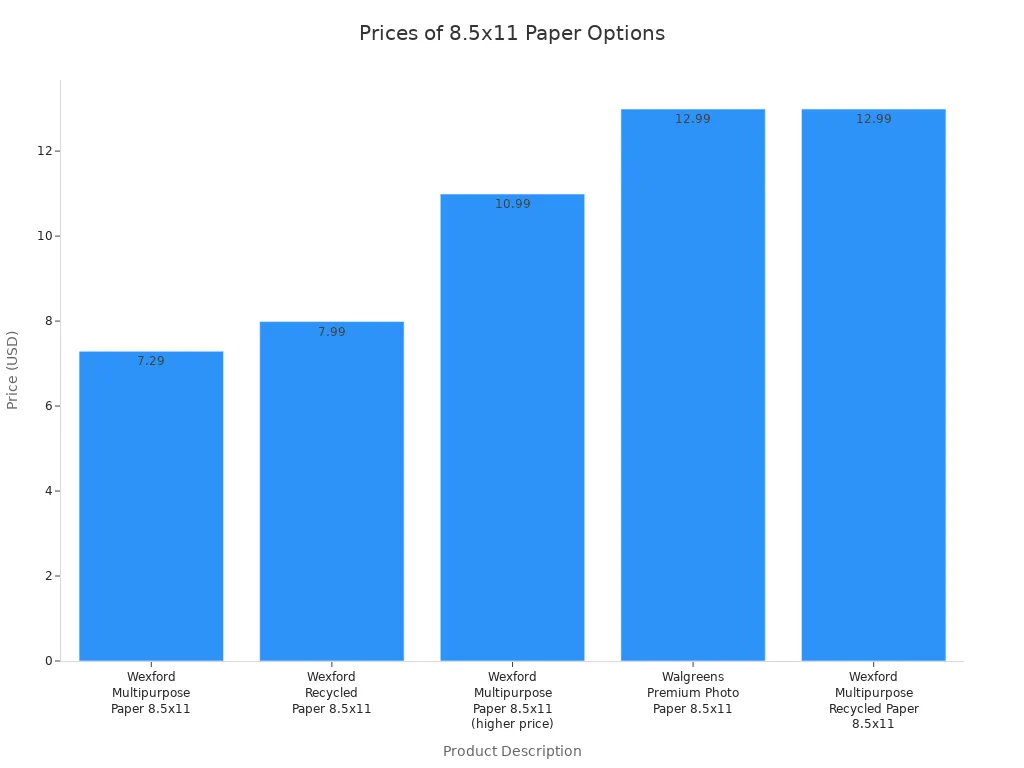
These choices are great for everyday printing without losing too much quality.
Mid-Range Choices
Mid-range paper is a good mix of cost and quality. You can expect better strength and print quality than budget paper. Look for papers that weigh about 24 lb and have a smooth finish. These are perfect for professional documents and presentations.
High-End Selections
If you want the best quality, high-end paper is the way to go. This type usually has heavier weights, special coatings, and unique textures. It’s great for art prints, marketing materials, or any project where you want to impress. While these options can cost more, they give amazing results that can improve your work.
Tip: When deciding between cost and quality, think about how strong you need the paper to be, how often you will use it, and your budget. Figure out what is most important for your projects. This way, you can find the right paper for your needs without spending too much.
Balancing cost and quality is very important. You want to make sure you get the best value for your money while still meeting your printing needs.
Choosing the right paper can really improve your printing projects. Think about the type of paper, its weight, finish, brightness, and texture. Each of these factors affects how your prints will look.
Tip: Before you buy, consider what you need for printing. If you have a tight budget, find options that are good quality but not too expensive.
Look at the table below for insights from recent consumer reviews on 8.5x11 paper:
Aspect | Digital Printing Disadvantages | |
|---|---|---|
Paper Choice | Lower cost for full color printing | Limited paper choice due to equipment constraints |
Production Time | Shorter production times for tight deadlines | Limited final piece size (mostly 13"x19") |
Print Quality | Cost-effective for low volume printing | Lower print quality, potential color inconsistency |
Best Use Case | Ideal for less than 2500 pieces, limited budget, quick turnaround | Not suitable for high-quality, large format needs |
By knowing these aspects, you can make smart choices that fit your printing needs.
FAQ
What weight of 8.5x11 paper should I choose for everyday printing?
For everyday printing, 20 lb paper is a good choice. It’s affordable and works for most documents. If you want something stronger, try 24 lb paper for better quality.
Can I use cardstock in my regular printer?
Yes, you can use cardstock in most inkjet and laser printers. Just check your printer's manual to see if it can handle thicker paper. Change the settings for the best results.
What’s the difference between matte and glossy finishes?
Matte finishes have a non-shiny surface, making text easy to read. Glossy finishes make colors and images look brighter and more vivid. Pick one based on what your project needs!
How do I know if my paper is bright enough?
Look at the brightness rating, which usually goes from 80 to 100. Higher numbers mean brighter paper, making colors stand out and text easier to read. For important documents, choose brighter paper.
Is recycled paper a good option for printing?
Yes! Recycled paper is good for the environment and works well for everyday printing. Just make sure it meets your quality needs for specific projects. It’s a smart choice for those on a budget.