Choosing the Right Nitrogen Generator: Key Features and Benefits to Consider


Nitrogen generators are very important in many industries as they provide necessary gas for different uses. Understanding what a nitrogen generator is used for can help you determine what your business needs. The worldwide market for nitrogen generators is growing fast, valued at USD 483.97 million in 2024 and expected to reach USD 634.52 million by 2033. This growth reflects an increase in working units, which have risen from 83,000 to over 120,000 in just five years.
Key Takeaways
Know the nitrogen purity needs. Different industries require certain purity levels. Pick a generator that meets these needs for good product quality.
Think about the flow rate and capacity. Figure out your nitrogen use to choose a generator that can handle high demands and future growth.
Check the total cost of ownership. Look past the first purchase price. Include maintenance and running costs for a full financial view.
Focus on energy efficiency. Choose a generator that reduces energy waste. This choice can save you a lot of money over time.
Plan for growth. Pick a nitrogen generator that can change with your needs. This flexibility helps you succeed in the long run.
Nitrogen Applications

Nitrogen generators are very important in many industries. They supply the needed nitrogen gas for different uses. This helps improve efficiency and product quality. Here are some main areas that use nitrogen generators:
Industrial Uses
Many industries depend on nitrogen generators for their work. The most common areas include:
Aerospace
Pharmaceuticals
Electronics
Oil and Gas
Among these, the food and beverage industry has the biggest market share. This area uses nitrogen to keep food fresh and make it last longer.
Food Packaging
In food packaging, nitrogen has several key roles. It replaces oxygen in packages. This reduces oxidation and slows down spoilage. Here are some benefits of using nitrogen in food packaging:
It helps keep the packaging strong, stopping fragile items from breaking.
As an inert gas, nitrogen does not change the food's look or taste.
It creates a safe space that stops harmful bacteria and mold from growing.
Using nitrogen greatly cuts down oxidation. This leads to longer shelf life and better food safety. This method is popular with health-conscious buyers because it lowers the need for chemical preservatives.
Electronics Manufacturing
Electronics manufacturing also gains from nitrogen generators. High purity nitrogen is very important in this field. For example:
Semiconductor Manufacturing needs nitrogen purity as high as 99.9999% to stop wafer oxidation.
Electronics Packaging requires nitrogen purity above 99.99% to create an oxygen-free space.
LCD and OLED Manufacturing usually needs nitrogen purity of ≥99.999% to prevent oxidation during making.
By ensuring the right nitrogen purity, you can improve the reliability and stability of electronic parts.
Purity Requirements
Nitrogen purity is very important in many uses. Different industries need certain purity levels. These levels affect product quality and safety. Knowing these levels helps you pick the right nitrogen generator.
Understanding Purity Levels
Nitrogen purity levels can change a lot based on the use. For example, industrial uses often need purity levels from 95% to 99.999%. Here’s a quick look at nitrogen purity needs in different industries:
Industry/Application | Consequences of Not Meeting Standards | |
|---|---|---|
Food/Beverage Production | 98-99.5% | Shorter shelf life, bad flavor, spoilage |
Pharmaceutical Manufacturing | 97-99.99% | Contamination, changes in final product |
Electronics/Semiconductor Manufacturing | 99.99-99.999% | Defective products, poor performance |
Oil and Gas Industry | 95-99% | Higher risk of fire and explosion |
Plastics Manufacturing | 95-98% (injection molding) | Defective products, production problems |
Metal Processing | 95-99% (heat treatment) | Quality problems, weak structure |
Power Generation | 95-99.6% | Operational issues, safety risks |
Applications Requiring High Purity
Some uses need very high purity nitrogen. For example, semiconductor manufacturing needs nitrogen purity of 99.99% or more. Using lower purity nitrogen can cause big problems, like defective products and poor performance. Here’s a summary of the risks with lower purity nitrogen:
Application | |
|---|---|
Electronics | Stops oxidation and keeps controlled atmosphere. |
Semiconductor manufacturing | Ensures safe atmosphere during making processes. |
Pharmaceutics | Stops contamination and oxidation in drug making. |
Food and Beverages | Prevents oxidation and contamination in food making. |
Aerospace | Keeps controlled environment for sensitive equipment. |
Oil industry | Reduces risk of accidents from fires. |
Balancing Cost and Purity
When choosing a nitrogen generator, you need to balance cost and purity. Higher purity levels usually mean higher costs. For example, PSA nitrogen generators give purity levels from 95% to 99.9995%. On the other hand, bulk liquid nitrogen usually has a purity of 99.998%. Knowing your specific needs will help you make a good choice.
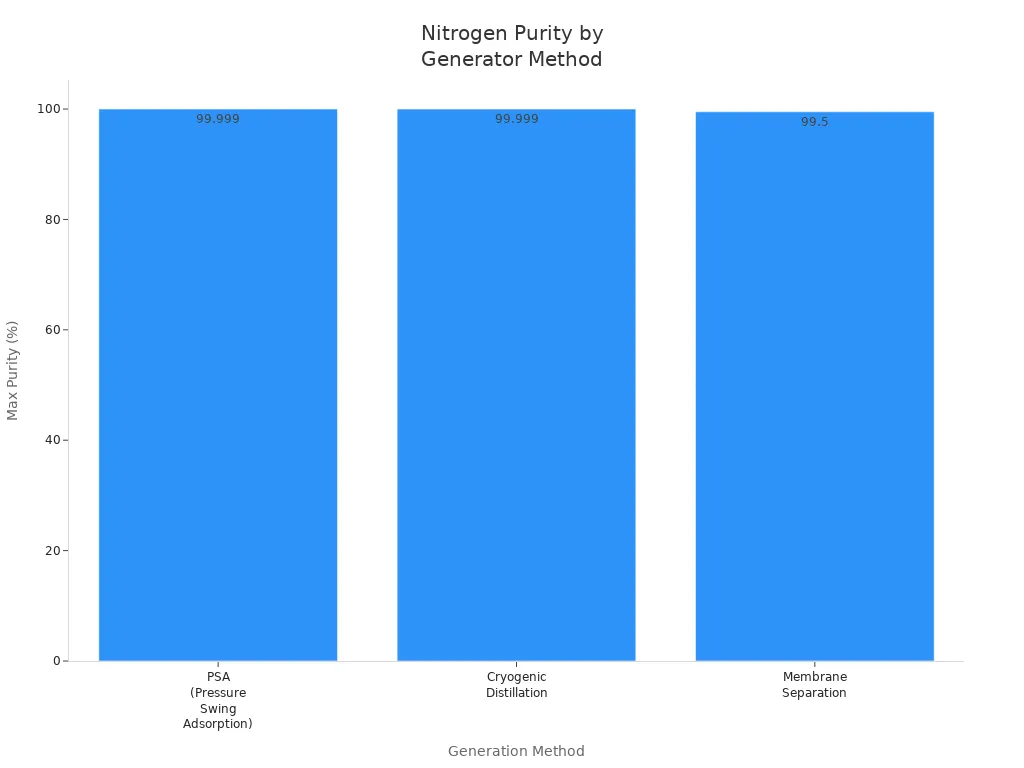
By carefully checking your application needs, you can find a nitrogen generator that fits your purity needs without spending too much.
Types of Nitrogen Generators
When you choose a nitrogen generator, you will find three main types: PSA (Pressure Swing Adsorption), Membrane Technology, and Cryogenic Systems. Each type works differently and has its own benefits.
PSA (Pressure Swing Adsorption)
PSA nitrogen generators use special towers to take nitrogen from air. This method gives a steady supply of nitrogen with medium purity levels.
Safe and steady operation without risks from pressurized tanks.
Convenient and on-demand supply, so no waiting for delivery.
Good for the environment, as they lower greenhouse gas emissions.
Disadvantages of PSA Generators:
High initial cost to set up.
Flow rate limits may affect some uses.
Membrane Technology
Membrane nitrogen generators use hollow polymer fibers that let certain gases pass through. This technology can provide different purity levels based on the membrane type and pressure.
Advantages of Membrane Generators:
Little maintenance needed, mostly just changing filters.
Disadvantages of Membrane Generators:
Higher running costs due to energy waste, especially at high purity.
Not as efficient as PSA systems, needing more compressed air.
Cryogenic Systems
Cryogenic nitrogen generators work by turning air into liquid and then separating it. This method makes very high purity nitrogen, which is great for strict uses like pharmaceuticals.
Scenario | Typical Output Capacity |
|---|---|
Petrochemicals | 8,000 Nm³/h |
Steel Metallurgy | 50,000 Nm³/h |
General Heavy Industries | Exceeds 3,500 Nm³/h |
Cryogenic systems are best when you need the highest purity. However, they have higher start-up costs and need more complex maintenance.
By knowing these types of nitrogen generators, you can choose the right one for your needs. Each type fits different uses, so think about what matters most for your work.
Key Factors to Consider
When you pick a nitrogen generator, many important factors affect your choice. Knowing these factors helps you find the right system for your needs.
Flow Rate and Capacity
You need to check the flow rate or amount of nitrogen gas needed for your work. Think about peak demand, continuous use, and changes in how much you use. Make sure the nitrogen generator can handle the highest flow rates and allow for future growth. To find out the flow rate you need, use this formula:
Flow rate = Usage demand / Flow rate coefficient
This formula helps you figure out how much nitrogen is needed for tasks like welding or packaging.
Energy Efficiency
Energy efficiency is very important when choosing a nitrogen generator. Proper sizing is key to avoid wasting energy. If the system is too big, it uses more compressed air than needed. If it’s too small, it might not meet your nitrogen flow and purity needs. Here are some energy efficiency points to think about:
PSA systems use a special material to separate nitrogen from oxygen. This can save energy in some cases.
Hollow Fiber Membrane systems filter oxygen with a semi-permeable membrane. This may also save energy based on how you use it.
By picking an energy-efficient generator, you can save a lot of money over time.
Maintenance and Support
Regular maintenance is important for your nitrogen generator to last long. Common maintenance tasks include:
Maintenance Activity | Frequency |
|---|---|
Equipment Inspection | Once a month |
Deep Cleaning and Maintenance | Once a quarter |
Comprehensive Overhaul | Once a year |
Regular maintenance helps find problems before they get worse. This reduces the chance of unexpected downtime. While nitrogen generators are made to last, remember to consider service intervals, filter changes, and spare parts when figuring out total ownership costs.
Cost Considerations
Knowing the costs of buying and running a nitrogen generator is very important. Here’s a list of typical cost parts:
Price Range | |
|---|---|
Small Flow Nitrogen Generators | $3,000 - $10,000 |
Mid Flow Nitrogen Generators | $10,000 - $50,000 |
Large Flow Nitrogen Generators | $50,000 - $100,000+ |
Buffer Tanks | Several thousand dollars |
Compressors | $5,000 - $20,000 |
Dryers | $1,000 - $10,000 |
Storage Tanks | $1,000 - $10,000+ |
Electricity Consumption | Varies based on usage |
Labor Costs | Negligible |
Equipment Maintenance Costs | Regular filter replacements |
Equipment Depreciation Costs | Over 10 years |
By thinking about these factors, you can make a smart choice that balances efficiency, cost, and operational needs.
What is a Nitrogen Generator Used For?
Nitrogen generators are very important in many industries. They give nitrogen gas for different uses, which helps with efficiency and safety. Here are some main uses of nitrogen generators:
Food Packaging: Nitrogen replaces oxygen in packages. This helps keep perishable foods fresh longer.
Chemical Blanketing: Nitrogen lowers oxygen in dangerous areas. This helps stop fires and explosions.
Electronics: Nitrogen lowers surface tension when soldering. It also stops computers from overheating.
Laboratory: Nitrogen controls oxygen, humidity, and temperature for sensitive tasks.
Laser Cutting: Nitrogen works as a purging gas. This improves the quality of steel products.
Making nitrogen on-site has many benefits compared to traditional supply methods. Here are some advantages:
Cost Efficiency: On-site generation costs about $0.08 to $0.14 per 100 CF. Traditional supply can cost $0.40 to over $3.00 per 100 CF. You can see a return on investment in 6 to 24 months.
Consistent Supply: On-demand production means you get nitrogen only when you need it. This stops gas loss and ensures a steady supply.
Safety: On-site generation removes risks from handling cylinders and dewars. You have better control over nitrogen purity for your specific needs.
Environmental Benefits: Making nitrogen on-site uses less energy than delivery methods. It also cuts down waste from returning empty cylinders and reduces boil-off losses. This helps lower your carbon footprint.
By using nitrogen generators, you can improve processes and product quality. For example, in manufacturing, nitrogen creates a controlled space with low oxygen. This setup lowers the risk of oxidation, moisture damage, and bacteria or mold growth. As a result, you get better product quality, longer shelf life, and less spoilage.
Choosing the right nitrogen generator is very important for your work. Here are the main points to think about:
Purity requirements: Different tasks need different purity levels. This affects which type of generator you choose.
Flow rate: Make sure the generator fits your nitrogen use. This helps avoid wasting resources.
Cost of ownership: Don’t just look at the starting price. Think about maintenance and running costs too.
Scalability: Pick systems that can grow with your needs or changes in demand.
By paying attention to these points, you can make a smart choice that improves efficiency and fits your needs. Getting the right nitrogen generator will help your work and lead to long-term success. 🌱
FAQ
What is a nitrogen generator?
A nitrogen generator makes nitrogen gas right where you need it. It uses methods like PSA, membrane technology, or cryogenic systems. This means you don’t need outside gas supplies. It gives you a steady and cost-effective source of nitrogen.
How do I choose the right nitrogen generator?
To pick the right nitrogen generator, think about your purity needs, flow rate, energy use, and maintenance. Check your specific uses to make sure the generator fits your work demands.
What are the benefits of on-site nitrogen generation?
Making nitrogen on-site saves money, gives a steady supply, and improves safety. You don’t have to handle gas cylinders. It also helps the environment by cutting down transportation emissions.
How often should I maintain my nitrogen generator?
You should regularly maintain your nitrogen generator. Do monthly checks, clean it deeply every three months, and do a full check-up once a year. This keeps it working well and lasting longer.
Can I use a nitrogen generator for food packaging?
Yes, nitrogen generators work great for food packaging. They replace oxygen in packages. This helps keep food fresh longer and prevents spoilage and oxidation.