Comparative Analysis of Different Oxygen Nitrogen Gas Plant Technologies

Understanding different oxygen nitrogen gas plant technologies is very important. Many industries need oxygen and nitrogen from these gas plants. These gases help make processes better and improve product quality. This is true in areas like manufacturing and healthcare. Recently, more companies in North America and Europe are using these oxygen nitrogen gas plant technologies. This is because of strict industrial rules. A comparison of these technologies can help industries choose the best oxygen nitrogen gas plant for their needs. This choice can save money and improve how they operate.
Key Takeaways
Knowing the three main technologies—Cryogenic, PSA, and Membrane—helps industries pick the best choice for their needs.
Cryogenic technology gives the highest purity levels for oxygen and nitrogen. This makes it great for big industrial uses.
PSA technology saves energy and is flexible. It works well for medium-sized uses like healthcare and food processing.
Membrane technology is cheap and saves space. It is good for small operations but has lower purity levels.
When choosing a technology, think about purity needs, production size, and budget to find the best match for your industry.
Cryogenic Technology

Cryogenic Principles
Cryogenic technology uses low-temperature physics to separate gases. First, air is compressed and impurities like water, hydrocarbons, and carbon dioxide are removed. Then, the air is cooled by exchanging heat with colder nitrogen and oxygen. This cooling gets the air ready for more processing. The cooled air is expanded to almost saturation temperatures of oxygen and nitrogen.
The cold mixture goes into a rectification column, where separation happens. Oxygen has a higher boiling point, so it becomes richer in the liquid phase. Nitrogen has a lower boiling point, so it rises and becomes richer in the gas phase. Using more rectification columns can improve purity levels. The table below shows the steps in cryogenic separation:
Step | Description |
|---|---|
1 | Air is compressed and impurities (water, hydrocarbons, carbon dioxide) are removed. |
2 | The air is cooled through heat exchange with colder nitrogen and oxygen flows. |
3 | The cooled air is expanded to near saturation temperatures of oxygen and nitrogen. |
4 | The cold mixture is fed into a rectification column. |
5 | Oxygen, having a higher boiling point, becomes richer in the liquid phase while nitrogen becomes richer in the gas phase as they ascend and descend the column. |
6 | The process can be enhanced using multiple rectification columns for higher purity. |
Cryogenic Characteristics
Cryogenic oxygen nitrogen gas plants have important operational features. These plants can produce oxygen with over 99.5% purity and nitrogen with more than 99.99% purity. They can create between 100 to over 5,000 tons per day (TPD) of oxygen, making them great for large industries. They are also very reliable, with uptime usually over 99%.
However, this process uses a lot of energy. It needs a lot of electricity to keep low temperatures. Higher purity often means more energy use. Maintenance is easy because these plants can be monitored and controlled from a distance. This means fewer staff are needed on-site, and one operator can run the plant from a control room. The table below lists these features:
Characteristic | Details |
|---|---|
Purity of Products | Oxygen purity can exceed 99.5%; nitrogen purity can exceed 99.99%. Argon can only be produced by cryogenic air separation. |
Production Capacity | Can produce 100 to over 5,000 tons per day (TPD) of oxygen. |
Reliability | Uptime typically exceeds 99%. |
Energy Consumption | The process is energy intensive, consuming electricity to maintain required temperatures. Higher purity results in higher energy consumption. |
Maintenance | Monitored and controlled remotely, allowing for efficient operation with minimal onsite staff. A single operator can manage the plant from the control room. |
Cryogenic Applications
Cryogenic technology has a long history and is used in many industries. It started in the 1930s when the Junkers Company in Germany first used it for military airplane parts. This early use was important for making the Jumo 1,000 HP V-12 aircraft engine. By the mid-1950s, engineers began using it for chainsaw blades, marking a big step in cryogenics beyond aviation.
Today, industries like steel manufacturing and general applications depend on cryogenic technology. Steel plants often need large amounts of oxygen, producing between 10,000 to 30,000 Nm³/h. General industry applications usually require over 5,000 Nm³/h. The table below shows production scales and technologies used in different industries:
Industry | Production Scale (Nm³/h) | Technology Used |
|---|---|---|
Steel Plants | 10,000 - 30,000 | Cryogenic Distillation |
General Industry | > 5,000 | Cryogenic Distillation |
Smaller Applications | 0 - 5,000 | PSA Technology |
Cryogenic technology keeps improving to meet modern needs for efficiency and reliability. Its ability to provide high purity (>99.5%) and large output makes it perfect for industries that need a lot of gas. Combining cryogenic and PSA technologies is a growing trend, making it easier to adapt to different needs.
PSA Technology
PSA Principles
Pressure Swing Adsorption (PSA) technology separates gases by their size and how they stick to surfaces. The process has a few important steps:
Stage | Description |
|---|---|
Adsorption | Compressed air goes into a special filter under high pressure. Smaller molecules, like oxygen, stick to the filter while larger ones, like nitrogen, go through. |
Desorption | When the filter is full, workers lower the pressure. This makes the stuck molecules come off and be released, cleaning the filter for the next round. |
Pressure Equalization | Air from the pressurized tower moves to another tower to balance the pressure. This step saves air and makes the system work better. |
Molecular sieves are very important in this process. They absorb gas molecules based on their size and shape. Carbon Molecular Sieves (CMS) are used to separate nitrogen, while Zeolite Molecular Sieves (ZMS) help produce oxygen.
PSA Characteristics
PSA technology has several features that make it good for oxygen nitrogen gas plants:
Characteristic | Description |
|---|---|
Cycle Time | Longer cycles help separate gases better and improve product quality but may lower total output. |
Energy Use | Changing cycle times affects how much energy is used. Adjusting these times can save energy. |
Product Purity | PSA usually gets oxygen purity levels between 90% and 95%. Higher purity needs longer sticking times or higher pressures. |
Being able to control purity and flow rate is a big plus for PSA systems. Workers can change settings to fit specific needs. But, higher purity can lead to lower overall output.
PSA Applications
PSA technology works well for large applications. It can meet the needs of many industries, like healthcare, manufacturing, and food processing. This technology effectively makes oxygen and nitrogen for these fields.
However, PSA systems have some downsides. They need a lot of space and different parts, making them less compact than regular storage methods. Also, PSA technology is sensitive to things like humidity and CO₂, which can hurt performance.
Membrane Technology
Membrane Principles
Membrane technology uses a special process to separate gases. Here are the main ideas:
Principle | Description |
|---|---|
Small gas molecules, like oxygen, dissolve into the membrane's polymer chains. | |
Diffusion Process | The dissolved gas molecules move through the membrane because of concentration differences. Faster gases, like oxygen, pass through more easily. |
Product Collection | As gas moves through the membrane, the nitrogen becomes purer, meeting quality standards. |
This technology helps separate oxygen and nitrogen from air efficiently. That's why many industries like to use it.
Membrane Characteristics
Membrane technology has important features that improve its use in oxygen nitrogen gas plants:
Characteristic | Description |
|---|---|
Selectivity | It separates nitrogen from air using selective permeation. This lets faster gases, like oxygen, pass through quickly. |
Durability | The system controls nitrogen purity and flow, making it more durable and efficient. |
Environmental Impact | The process is eco-friendly, focusing on saving energy and being easy to operate. |
Membrane systems produce gas continuously, take up little space, and are good for the environment. They also save energy, making them cheaper than older methods.
Membrane Applications
Membrane technology is very important in gas separation today. It can be used for:
Separating hydrogen from gases like nitrogen and methane
Recovering hydrogen from ammonia plant products
Adding oxygen to air for medical or metal work
Removing water vapor from natural gas and other gases
These uses show how flexible membrane technology is in different fields, like healthcare, manufacturing, and energy.
Membrane technology is known for being cheaper than traditional cryogenic methods. It can achieve high selectivity and efficiency, making it a popular choice for many oxygen nitrogen gas plants.
Comparative Analysis of Technologies
Purity Levels
Purity levels are very important when looking at oxygen nitrogen gas plant technologies. Each technology gives different purity levels for oxygen and nitrogen. The table below shows the purity levels for each method:
Technology | Purity of Nitrogen (N₂) | Purity of Oxygen (O₂) |
|---|---|---|
PSA | Up to 99.999% | Up to 95% |
Membrane | Up to 99.5% | Up to 45% (not pure oxygen) |
Cryogenic ASU | Up to 99.999% | Up to 99.5% |
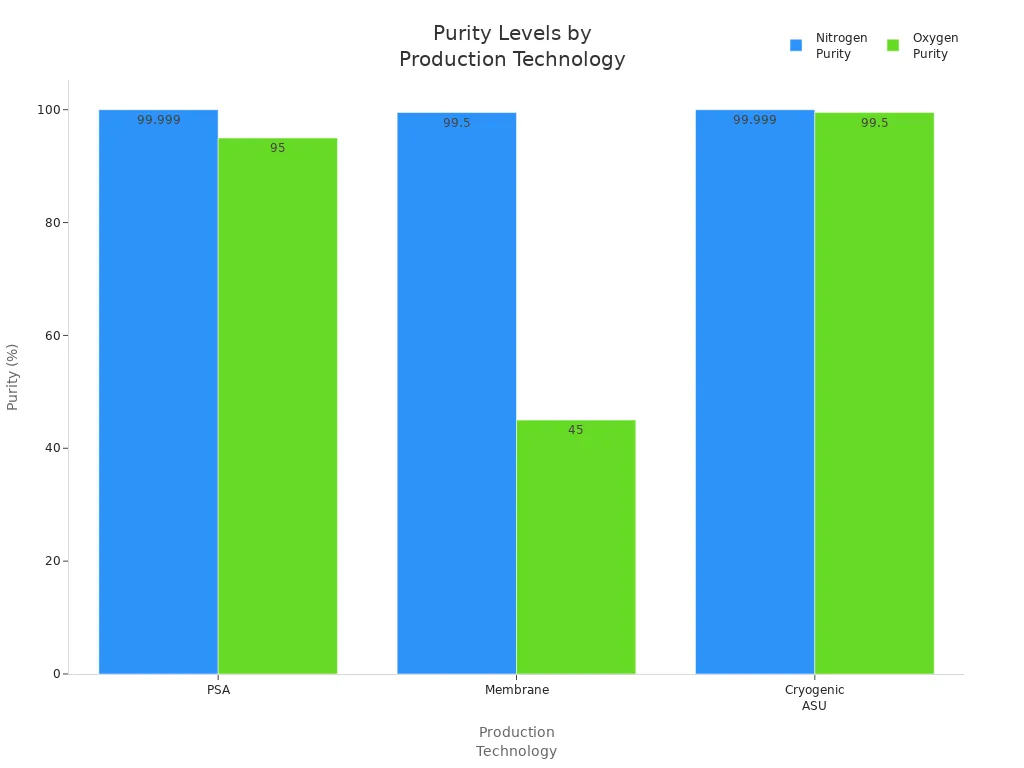
Cryogenic technology is best for high purity levels. This makes it great for industries that need ultra-pure gases. PSA technology also gives high purity but is a bit lower than cryogenic systems. Membrane technology is efficient but has lower purity levels, especially for oxygen.
Production Capacity
Production capacity is very different among the technologies. Cryogenic plants can make a lot of oxygen, from 100 to over 5,000 tons per day (TPD). PSA systems usually have lower production capacities and are better for smaller applications. Membrane systems also meet lower production needs, making them good for specific uses where high volume is not needed.
Cryogenic Technology: Best for large industries like steel manufacturing, meeting high demand.
PSA Technology: Good for medium-scale uses, often in healthcare and food processing.
Membrane Technology: Great for small operations, like labs or specialized manufacturing.
Cost Considerations
Cost is a big factor when picking an oxygen nitrogen gas plant technology. The table below shows the capital and operational costs for each technology:
Plant Type | Capital Costs | Operational Costs |
|---|---|---|
PSA Oxygen & Nitrogen Plants | Lower than cryogenic | Lower energy use |
Cryogenic Oxygen & Nitrogen Plants | Higher because of special equipment | Higher due to energy needs |
Cryogenic systems need a bigger initial investment because of special equipment. But they offer high purity and large production capacity. PSA systems have lower capital and operational costs, making them appealing for many industries. Membrane systems also have lower costs but might need more maintenance.
Application Suitability
Choosing the right technology depends on what you need. Here are some points to think about:
High-Purity Medical Oxygen: PSA technology is best for making medical-grade oxygen. It works well at normal temperatures and pressures, so it doesn't need energy-heavy cryogenic processes. PSA systems can keep high purity levels, which is very important for medical uses.
Industrial Applications: Cryogenic technology is good for large-scale industrial uses, like steel manufacturing, where a lot of oxygen is needed.
Small-Scale Operations: Membrane technology is great for smaller uses, like labs or specialized manufacturing, where space and budget are limited.
The comparison shows clear pros and cons for each technology.
Cryogenic technology is great at making very pure gases. This makes it best for big industrial uses. But, it needs a lot of energy and money.
PSA technology is flexible and has lower running costs. It works well for medium-sized applications. It gets good purity levels but might not reach the highest ones.
Membrane technology is cheap and saves space, making it good for smaller operations. However, its lower purity levels limit its use in important applications.
Tips for choosing technology:
For 99 – 99.999% purity, pick PSA generators.
For 95-99% purity, think about membrane generators.
Check nitrogen flow rates, budget limits, and available space before deciding.
New improvements in these technologies make them more efficient and help meet industry rules, keeping them competitive in the market.
FAQ
What is the main difference between cryogenic and PSA technologies?
Cryogenic technology uses very low temperatures to separate gases. This method gets higher purity levels. PSA technology uses pressure changes to separate gases. It is more energy-efficient but has slightly lower purity.
How does membrane technology work?
Membrane technology separates gases by letting smaller molecules, like oxygen, pass through a special membrane. Larger molecules, like nitrogen, stay behind. This process is efficient and saves space.
What industries benefit from oxygen nitrogen gas plants?
Industries like healthcare, manufacturing, and food processing gain a lot from oxygen nitrogen gas plants. These plants provide important gases for many uses, improving efficiency and product quality.
Can PSA technology produce high-purity oxygen?
Yes, PSA technology can make oxygen with purity levels up to 95%. However, it may not reach the very high purity levels that cryogenic systems can achieve.
What are the cost implications of using cryogenic technology?
Cryogenic technology usually needs higher capital and operational costs because of special equipment and energy use. But, it provides high purity and large production capacity, which can make the investment worth it for big applications.