Maximizing ROI with Onsite Oxygen Generators for Biogas Plants

Onsite oxygen generators for biogas are very important. They help improve production and make more money. These systems give a steady supply of oxygen. This helps biogas plants produce more. Think about the improvements you can make:
Improvement Type | Description |
|---|---|
Reliability | Onsite systems provide a constant supply of oxygen. This means you do not rely on outside sources. |
Cost-efficiency | Making oxygen onsite is much cheaper over time than buying it from others. |
Process fit | The oxygen purity of 93–95% works well for the desulfurization process. No need for super high purity. |
Scalability | The design is modular. This makes it easy to upgrade when more oxygen is needed in biogas plants. |
Compact footprint | They come in standalone or container forms. This makes installation and moving easier. |
Using these generators can lead to more production and big improvements in operations.
Key Takeaways
Onsite oxygen generators give a constant supply of oxygen. This helps make more biogas and boosts profits.
These systems save money. They cut costs on transport and storage by making oxygen right where it is needed.
Using onsite generators makes things safer. There is no need to handle risky oxygen tanks.
To get the best results, regular maintenance and professional installation are important for onsite oxygen generators.
Buying onsite oxygen generators can pay off quickly, usually in 1.5 to 3 years.
Understanding Onsite Oxygen Generators for Biogas
Definition and Function
Onsite oxygen generators are machines that make oxygen right at biogas plants. They use smart technology, like Pressure Swing Adsorption (PSA), to take oxygen out of nitrogen in the air. This process has some important parts:
Zeolite molecular sieves that help separate gases well.
An automated control system that keeps everything running smoothly.
A modular design that lets you change the oxygen supply based on what you need.
These generators give a steady and cheap oxygen supply. This is very important for boosting biogas production.
Role in Biogas Production
In biogas production, oxygen has a special job. Anaerobic digestion needs no oxygen, but onsite oxygen generators help control hydrogen sulfide (H₂S) levels. By adding clean oxygen to the biogas, you can react with H₂S. This changes it into sulfur and water. This process not only makes the biogas better but also keeps your equipment safe from damage.
The benefits of using onsite oxygen generators are big. They provide:
Benefit | Description |
|---|---|
Making oxygen yourself saves money on transport and storage costs. | |
Improved safety | You don’t have to handle dangerous oxygen tanks, which makes things safer. |
Increased efficiency | Gives a steady supply of oxygen, which helps remove H₂S during biogas production. |
Environmentally friendly | Lowers the carbon footprint from moving and storing oxygen. |
By using onsite oxygen generators for biogas, you can make your biogas production process work better while cutting down on costs.
Benefits of Onsite Oxygen
Increased Biogas Yield
Onsite oxygen generators for biogas help make more methane and better gas quality. They give a steady supply of oxygen. This helps remove harmful hydrogen sulfide (H₂S) from biogas. The desulfurization process improves gas quality. It also protects your equipment from damage caused by corrosive materials.
Here are some key advantages of using onsite oxygen generators:
Key Advantages | Description |
|---|---|
Desulfurization efficiency | Helps remove harmful H₂S from biogas. |
Cost savings | No need to rely on outside oxygen deliveries. |
Remote operation | You can monitor and control systems from far away. |
Scalable solutions | Can be adjusted for different biogas production sizes. |
Low maintenance | Strong systems that need little upkeep. |
By adding onsite oxygen generators to your biogas plant, you can see a big increase in biogas yield. This leads to more profit and better operations.
Improved Digestion Rates
Onsite oxygen generators also help speed up digestion rates in biogas production. These systems provide a reliable oxygen source. This is important for boosting microbial activity. When oxygen levels are just right, it helps good microorganisms grow. This means organic materials break down faster, leading to better biogas production.
Consider the following benefits of improved digestion rates:
Onsite oxygen generators give a constant supply of oxygen, which is key for boosting microbial activity in biogas production.
They help cut down harmful substances like hydrogen sulfide, making biogas better.
Using these generators increases operational efficiency by providing a steady oxygen source without needing outside deliveries.
By using onsite oxygen generators, you improve the quality of your biogas and make your production process smoother. This leads to better energy yields and a more sustainable operation.
Cost Analysis of Onsite Oxygen Generators
Initial Investment Breakdown
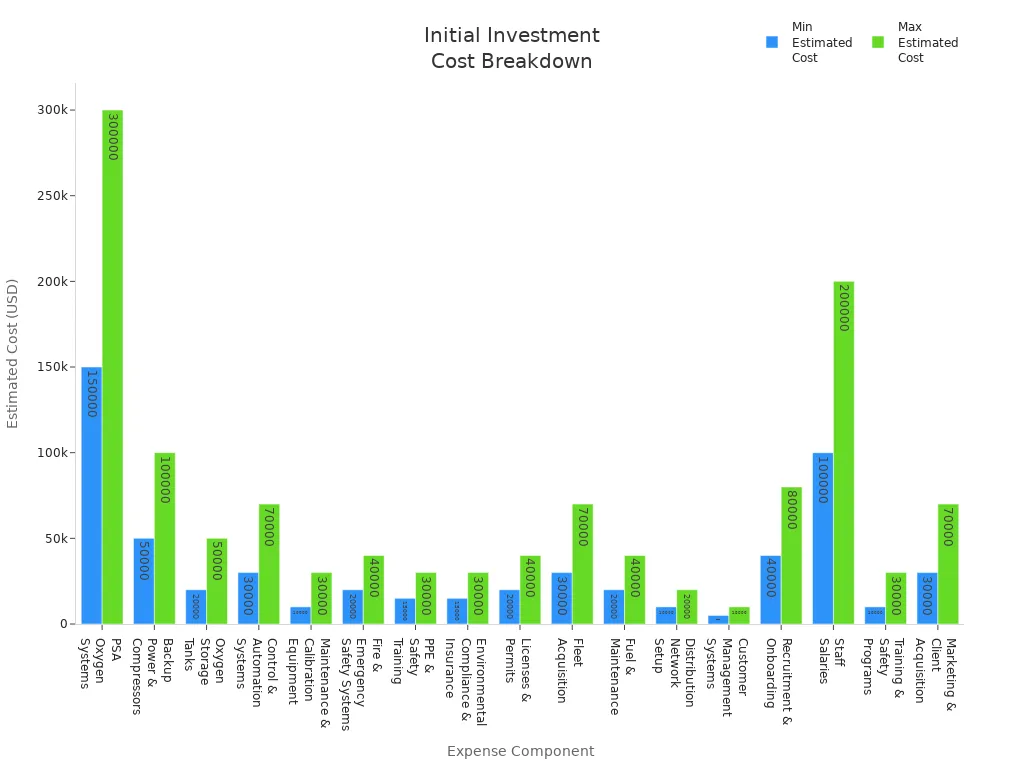
When you think about onsite oxygen generators for your biogas plant, knowing the initial costs is very important. The usual cost to install these systems is between $680,000 and $1,360,000. This money pays for different parts needed for them to work well. Here’s a list of the main costs involved:
Expense Component | Estimated Cost | Notes |
|---|---|---|
$150,000 - $300,000 | Main equipment for making high-purity oxygen | |
Backup Power & Compressors | $50,000 - $100,000 | Keeps everything running and saves energy |
Oxygen Storage Tanks | $20,000 - $50,000 | Safe and compliant storage for oxygen |
Control & Automation Systems | $30,000 - $70,000 | Improves reliability and safety checks |
Maintenance & Calibration Equipment | $10,000 - $30,000 | Helps keep quality and uptime |
Fire & Emergency Safety Systems | $20,000 - $40,000 | Includes fire safety systems and emergency plans |
PPE & Safety Training | $15,000 - $30,000 | Covers protective gear and safety training for staff |
Environmental Compliance & Insurance | $15,000 - $30,000 | Covers assessments, audits, and insurance costs |
Licenses & Permits | $20,000 - $40,000 | Includes business and environmental permits |
Fleet Acquisition | $30,000 - $70,000 | Vehicles for transporting oxygen |
Fuel & Maintenance | $20,000 - $40,000 | Ongoing costs for operations |
Distribution Network Setup | $10,000 - $20,000 | Costs for route planning and software |
Customer Management Systems | $5,000 - $10,000 | Helps with order processing and tracking |
Recruitment & Onboarding | $40,000 - $80,000 | Covers hiring and training new staff |
Staff Salaries | $100,000 - $200,000 | For operators, engineers, and office staff |
Training & Safety Programs | $10,000 - $30,000 | Courses for technical skills and safety certifications |
Marketing & Client Acquisition | $30,000 - $70,000 | Money spent on marketing and getting clients |
Ongoing Cost Reductions
Buying onsite oxygen generators needs a big initial payment but can save you a lot of money later. Here are some key ways these systems help you save money over time:
Elimination of Transport Costs: You won’t need to move and store oxygen tanks anymore. This cuts down on costs and lowers safety risks.
Reliable Oxygen Supply: Onsite generators give a steady supply of oxygen. This means you can keep working without expensive downtime.
Enhanced Process Control: With better control over how things work, you can be more efficient. This leads to better products and less waste.
By knowing the initial costs and seeing how much you can save later, you can make smart choices about using onsite oxygen generators in your biogas plant. This smart investment not only makes your operations better but also helps you get more money back over time.
Case Studies of Successful Implementations
Real-World Examples
Many biogas plants have added onsite oxygen generators to their work. Here are some important examples:
Green Energy Biogas Plant: This plant in California raised its methane yield by 25% after adding an onsite oxygen generator. The generator helped lower hydrogen sulfide levels. This improved gas quality and made equipment last longer.
EcoWaste Solutions: Located in Texas, this plant used onsite oxygen generation. They saw a 30% drop in operational costs. The steady oxygen supply boosted microbial activity, which sped up digestion rates.
Renewable Power Systems: In New York, this biogas plant added an onsite oxygen generator. They achieved a 20% rise in total biogas production. The generator also cut down the need for outside oxygen deliveries, making operations smoother.
Measurable ROI Outcomes
The return on investment (ROI) from these projects has been very good. Here are some clear results:
Biogas Plant | Increased Yield (%) | Cost Savings (%) | Payback Period (Years) |
|---|---|---|---|
Green Energy Biogas Plant | 25% | 15% | 2 |
EcoWaste Solutions | 30% | 20% | 1.5 |
Renewable Power Systems | 20% | 18% | 2.2 |
Tip: When thinking about onsite oxygen generators, check both yield increases and cost savings. These will help you figure out your possible ROI better.
By looking at these case studies, you can see how onsite oxygen generators boost biogas production and provide big financial benefits. Investing in these systems can change your biogas operations, making them more efficient and profitable.
Best Practices for Implementation
Selecting the Right Generator
Picking the right onsite oxygen generator is very important for getting the most out of your biogas plant. Here are some key things to think about:
Production Capacity: Look at how much biogas you need to make. Choose a generator that can meet your current and future oxygen needs.
Purity Levels: Make sure the generator can create oxygen at the right purity levels (93-95%) for removing H₂S effectively.
Technology Type: Think about systems like Pressure Swing Adsorption (PSA) or membrane separation. Each type has its own benefits based on what you need.
Supplier Reputation: Check out suppliers like NOVAIR and GraniteFuel Engineering. Their solutions work well for combining oxygen production with H₂S removal, which helps overall efficiency.
By looking closely at these factors, you can choose a generator that fits your goals and budget.
Installation and Maintenance Tips
Good installation and maintenance of your onsite oxygen generator will help it work well. Follow these tips:
Professional Installation: Hire skilled technicians for the setup. They can make sure everything is installed and calibrated correctly.
Regular Maintenance: Plan routine checks. This includes looking at filters, valves, and control systems to avoid unexpected problems.
Monitor Performance: Use monitoring systems to keep track of oxygen production and H₂S levels. This information helps you adjust operations for the best results.
Training Staff: Teach your team how to operate and maintain the generator. Well-trained staff can quickly fix problems and keep everything running smoothly.
GraniteFuel Engineering’s Oxygen Injection Technology shows good maintenance practices. By adding pure oxygen to the H₂S removal system, they help the removal media last longer. This means less frequent replacements and big cost savings.
By following these best practices, you can make sure your onsite oxygen generator works well. This will help increase biogas production and improve your ROI.
In conclusion, onsite oxygen generators are very important for getting the most money back from biogas plants. They have many benefits, such as:
Benefit | Explanation |
|---|---|
Onsite oxygen generators can save a lot of money over time. They help pay back the initial costs by lowering running costs. | |
Increased Safety | They lower risks from high-pressure oxygen tanks. This makes the workplace safer and cuts down on accidents. |
Reliable and Continuous Supply | Onsite generators provide a steady flow of oxygen. This stops production delays from running out of outside supplies. |
Enhanced Environmental Impact | They cut down the carbon footprint from moving oxygen. This helps meet environmental goals. |
When you think about using these systems, remember they keep biological activity steady. They also lower harmful by-products like hydrogen sulfide (H₂S) and cut down on running costs. Future trends, like smart upgrades and using renewable energy, promise even better efficiency and sustainability.
Check out resources like PCI's VSA Oxygen Generating Systems to improve your operations. By using onsite oxygen generators, you can greatly boost your biogas production and profits.
FAQ
What are onsite oxygen generators?
Onsite oxygen generators make oxygen right at biogas plants. They use methods like Pressure Swing Adsorption (PSA) to pull oxygen from the air. This gives a steady and affordable supply.
How do onsite oxygen generators improve biogas production?
These generators help biogas production by giving a constant oxygen supply. This helps get rid of harmful hydrogen sulfide (H₂S). It improves gas quality and keeps equipment safe from harm.
What are the maintenance requirements for these generators?
Regular maintenance means checking filters, valves, and control systems. Plan routine checks to keep everything working well and avoid unexpected problems.
How long does it take to see ROI from onsite oxygen generators?
Most biogas plants see a return on investment in 1.5 to 3 years. The exact time depends on things like initial costs, savings from operations, and more biogas production.
Can onsite oxygen generators be scaled up?
Yes, onsite oxygen generators have a modular design. You can easily upgrade or expand the system as your need for oxygen grows with more biogas production.